
Skip to Content
chevron-left chevron-right chevron-up chevron-right chevron-left arrow-back star phone quote checkbox-checked search wrench info shield play connection mobile coin-dollar spoon-knife ticket pushpin location gift fire feed bubbles home heart calendar price-tag credit-card clock envelop facebook instagram twitter youtube pinterest yelp google reddit linkedin envelope bbb pinterest homeadvisor angies

Top 10 Types of Dual Torch Pipeline Welding Machines

Choosing the right Dual Torch Pipeline Welding Machine can shape weld quality, production speed, and maintenance costs. Pipeline contractors face different conditions on every project. Pipe diameter, wall thickness, alloy type, joint design, and site access all influence machine selection.

This guide introduces ten practical machine types, including orbital systems, welding tractors, internal welders, external seam units, and fully automated platforms. Some models support narrow root gaps and controlled heat input. Others handle long circumferential joints with synchronized torches. A workshop may prefer a rigid frame, while a remote project may require compact equipment with simple field adjustments. Shielding gas delivery, wire feeding stability, torch alignment, and cooling capacity also deserve close attention.

John C. Lippold, a respected welding metallurgy expert, states, “Weldability is the capacity of a material to be welded under fabrication conditions.” That principle remains important here. A powerful machine cannot correct poor fit-up or an unsuitable welding procedure. Clean bevels matter. So does consistent preheating.

The classification is useful, but not perfect. Machine categories often overlap in real projects. A dual-torch tractor may also use orbital controls or automated monitoring. This article therefore compares each type through practical details, not marketing language. It considers operating environments, pipe sizes, automation levels, operator involvement, and inspection needs. Readers will see where each design performs well, where it struggles, and which selection mistakes can quietly increase rework. Small details often decide the result.
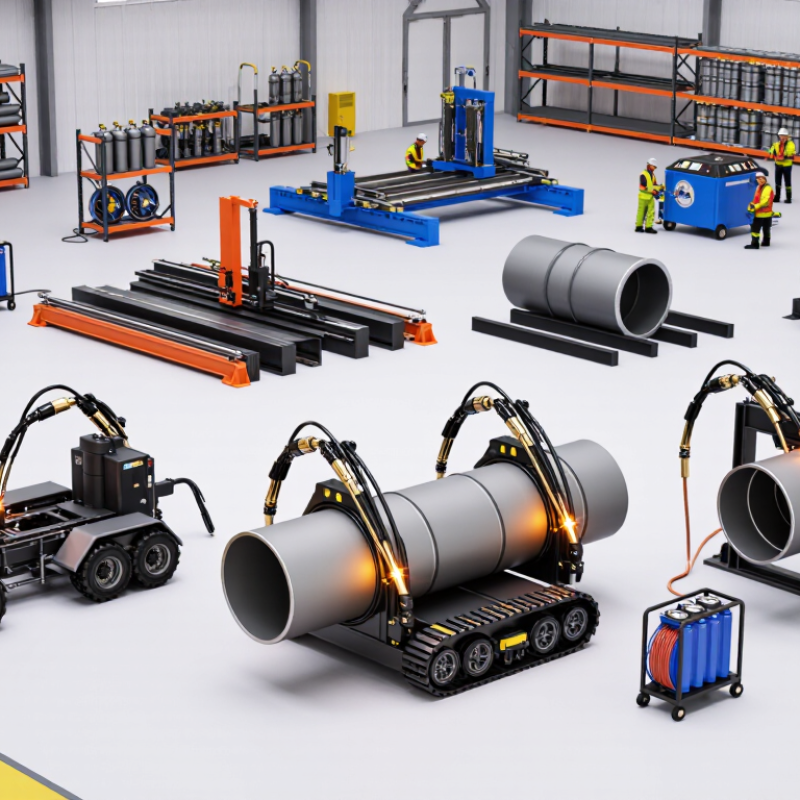
Top 10 Types of Dual Torch Pipeline Welding Machines

Definition and Working Principles of Dual Torch Pipeline Welding Machines

A dual torch pipeline welding machine uses two welding torches to join pipe sections with controlled heat and filler metal. The torches may work side by side, in tandem, or on opposite sides of a joint. The exact arrangement depends on pipe diameter, wall thickness, and welding procedure.

During operation, a carriage travels around the pipe joint at a steady speed. One torch usually starts the fusion process or preheats the joint. The second torch follows to add filler metal, shape the bead, or complete the pass. Sensors and control units regulate travel speed, arc current, voltage, and wire feed. This coordination helps distribute heat more evenly and can reduce welding time.

In practical field work, alignment matters greatly. A small gap between the pipe edges can change penetration and bead width. Clean surfaces also improve arc stability. Operators normally check torch angles, shielding gas flow, and cooling conditions before welding begins. The system is not foolproof. Excessive heat may distort thin pipe walls, while low heat can create incomplete fusion. Some machines also need careful adjustment when wind, vibration, or uneven pipe supports affect the joint. Skilled technicians still inspect the weld visually and through approved testing methods. Automation improves consistency, but it does not replace sound procedure control.

Classification Standards for Dual Torch Pipeline Welding Machines

Top 10 Types of Dual Torch Pipeline Welding Machines

Classification Standards for Dual Torch Pipeline Welding Machines

Dual torch pipeline welding machines should be classified by function, not appearance. The ten practical types include manual, mechanized, automatic, orbital, internal, external, fixed-frame, crawler, narrow-diameter, and heavy-wall models. Further distinctions include welding process, torch synchronization, pipe diameter, wall thickness, material, and operating position. API 1104 evaluates pipeline welding procedures, while ASME Section IX focuses on procedure and welder qualifications. ISO 12100 adds machinery risk-assessment principles. These standards describe performance and safety expectations, not a universal product ranking.

Field experience shows that torch independence matters. Some machines share one power source, while others control each torch separately. Separate control improves heat balancing on thick-wall joints. It also adds calibration work. The U.S. Bureau of Labor Statistics reported about 431,000 welding, cutting, soldering, and brazing jobs in 2024. Meanwhile, an American Welding Society workforce study projected a shortage of more than 300,000 welding professionals by 2026. This pressure supports automation, but automation is not automatically better. Poor tracking can leave uneven bead width, visible undercut, or excessive heat marks near the root.

Tips: Match the classification to the jobsite first. Check pipe diameter, joint design, alloy, power supply, and travel speed. Record torch offset before production. Inspect the root pass under actual lighting. Review ISO 3834 quality controls and the approved welding procedure. One overlooked detail remains common: two torches do not always mean twice the productivity. Crew skill, repositioning time, and cooling intervals can decide the real output.

Top 10 Types of Dual Torch Pipeline Welding Machines

Top 10 Types of Dual Torch Pipeline Welding Machines

Dual torch pipeline welding machines improve deposition rates and reduce repeated setup work. Their value depends on pipe diameter, wall thickness, joint design, and site conditions. A suitable machine should control travel speed, torch spacing, shielding gas, and heat input accurately. Poor coordination can create uneven penetration.

The ten common types serve different welding environments. Automatic orbital machines rotate torches around stationary pipes. Semi-automatic carriage machines support controlled field welding. Self-propelled crawlers travel along long pipeline sections. CNC gantry machines handle precise workshop fabrication. Girth welding machines focus on circumferential pipe joints. Internal welding machines reach accessible pipe interiors. External clamp machines stabilize torches around large-diameter pipes. Narrow-gap machines reduce filler metal consumption. Tandem arc machines place two arcs in a controlled sequence. Hybrid TIG and MIG machines combine clean root control with faster filling.

Field technicians usually inspect wheel alignment before each shift. They also check torch angles, cable routing, and gas flow near the joint. A small spacing error can change the bead profile. Wind protection matters, even when the machine appears enclosed. Some systems promise high speed but require frequent calibration. That trade-off is easy to underestimate. In my assessment, the best choice is rarely the fastest model. It is the machine that maintains repeatable weld quality across changing pipe sections. Trial welds, recorded parameters, and qualified inspection procedures should guide the final selection.

Top 10 Types of Dual Torch Pipeline Welding Machines
No. Machine Type Primary Welding Process Torch Arrangement Typical Pipe Diameter Typical Wall Thickness Typical Welding Speed Common Power Source Typical Pipeline Application Main Advantage
1 Dual-Torch GMAW Pipeline Buggy Gas metal arc welding (GMAW) Two tandem torches mounted on a mechanized carriage 16–48 in (406–1,219 mm) 6–20 mm 0.25–0.90 m/min Constant-voltage inverter, typically 300–500 A per torch Onshore transmission pipelines and long straight welds High deposition rate with consistent travel speed
2 Dual-Torch FCAW Pipeline System Flux-cored arc welding (FCAW) Leading and trailing torches positioned along the same weld path 20–56 in (508–1,422 mm) 8–25 mm 0.20–0.75 m/min Constant-voltage inverter, typically 350–550 A per torch High-strength steel transmission and gathering lines Strong penetration and good productivity in outdoor work
3 Dual-Torch GMAW/FCAW Combination Machine GMAW root or hot pass with FCAW fill and cap One torch dedicated to the front pass and one to fill or cap work 24–60 in (610–1,524 mm) 10–30 mm 0.18–0.65 m/min Two independent inverter power sources Large-diameter cross-country pipelines Combines controlled root welding with high-rate filling
4 Dual-Torch Tandem GMAW Machine Tandem gas metal arc welding Two wire electrodes arranged in tandem with a controlled arc distance 24–60 in (610–1,524 mm) 8–22 mm 0.35–1.20 m/min Dual-pulse or tandem GMAW power system, up to about 600 A per torch High-volume pipeline construction and repeatable girth welds Very high deposition rate and reduced cycle time
5 Dual-Torch GTAW Root-Pass Machine Gas tungsten arc welding (GTAW/TIG) Two GTAW torches operating on opposite or sequential sections 8–36 in (203–914 mm) 3–12 mm 0.05–0.25 m/min Constant-current power sources, typically 150–300 A per torch Stainless steel, alloy steel, and demanding root passes Excellent arc control and high-quality root penetration
6 Dual-Torch Orbital TIG Pipeline Welder Orbital GTAW with controlled wire feeding Two torches travel around the pipe on a synchronized orbital track 2–24 in (51–610 mm) 1.5–10 mm 0.03–0.18 m/min Programmable constant-current inverter, typically 100–250 A per torch Process piping, sanitary lines, and precision tube-to-pipe joints Repeatable weld profiles on small and medium diameters
7 Dual-Torch Submerged Arc Welding Machine Submerged arc welding (SAW) Two submerged arc heads positioned in tandem on an external track 30–72 in (762–1,829 mm) 12–40 mm 0.30–1.00 m/min Two constant-voltage SAW power sources, commonly 600–1,200 A per torch Fabricated pipe mills and thick-wall pipeline sections Deep penetration and high deposition with minimal arc glare
8 Dual-Torch Internal Line-Up Welding Machine Mechanized GMAW or FCAW Two torches mounted on an internal welding head or internal clamp 20–56 in (508–1,422 mm) 6–22 mm 0.20–0.80 m/min Portable inverter systems, typically 300–500 A per torch Field girth welding where internal access is available Accurate root alignment and reduced external setup time
9 Dual-Torch External Track Welding Machine Mechanized GMAW, FCAW, or hybrid arc welding Two torches travel around the outside of the pipe on a rigid track 24–60 in (610–1,524 mm) 8–28 mm 0.15–0.70 m/min Two synchronized inverter power sources, typically 300–550 A per torch Repair, tie-in, and field girth welds Fast installation and flexible access for field operations
10 Dual-Torch Hot-Wire TIG Pipeline Machine GTAW with hot-wire filler metal One torch creates the arc while a second torch or hot-wire circuit preheats filler wire 12–36 in (305–914 mm) 6–20 mm 0.10–0.45 m/min Constant-current TIG source with a separate hot-wire power unit Corrosion-resistant, alloy, and high-integrity pipeline welds Higher TIG deposition without sacrificing weld cleanliness

Key Features and Applications of Each Machine Type

Top 10 Types of Dual Torch Pipeline Welding Machines: Key Features and Applications of Each Machine Type

Dual-torch pipeline welders improve deposition speed by sharing heat between two synchronized torches. The first type is the orbital TIG machine, valued for precise root passes on stainless steel. Automated girth welders suit long, repetitive field joints. Internal line-up welders combine alignment and welding inside large-diameter pipe. External crawler welders travel around fixed pipe, reducing manual repositioning. Narrow-gap machines use smaller grooves and reduce filler consumption. Useful, but not universal.

Pulsed MIG systems control arc energy for thin-wall transmission lines. Tandem MIG machines place two arcs in one travel direction, increasing productivity on carbon steel. Flux-cored dual-torch units tolerate moderate outdoor conditions and offer strong deposition rates.

Submerged arc systems use granular flux and fit thick-wall pipe in controlled yards. Hot-wire TIG machines add heated filler wire, improving efficiency during corrosion-resistant cladding. Hybrid laser-arc systems create narrow, concentrated welds, although alignment demands are unforgiving.

The American Welding Society’s 2023 workforce report projects a United States welding shortage of about 330,000 professionals by 2028. This strengthens the case for automation, but training remains essential. Industry trials should measure arc-on time, repair rates, heat input, and operator workload. A machine that looks fastest may produce more corrections. Selection also depends on pipe diameter, wall thickness, material grade, access, and weather exposure. API and ASME procedures still require qualified welding procedures and inspection records.

How to Select the Right Dual Torch Pipeline Welding Machine

Selecting the right dual torch pipeline welding machine starts with the pipe, not the machine.

Define pipe diameter, wall thickness, joint design, steel grade, and welding process. Some systems run two arcs together. Others assign separate torches to root and fill passes. According to the American Welding Society’s 2023 Welding Workforce Data, the industry may need 330,000 additional welders by 2028. Automation helps, but labor shortages should not force a poor technical choice. Speed is only one variable.

Check torch spacing, carriage stability, cooling capacity, wire size, shielding gas, and power requirements. Confirm the machine can handle site fit-up variation and changing pipe positions. Request procedure qualification records and measured deposition rates, rather than accepting brochure claims. The 2024 Deloitte and Manufacturing Leadership Council survey found that 86% of manufacturers view smart manufacturing as important for competitiveness. That supports automation, but not blind automation. Verify welding procedures against applicable API 1104 or ASME B31.8 requirements.

Run a practical trial on three representative pipe sections. Measure arc starts, penetration, travel speed, spatter, and repair rates. Do not hide the weak points. Ask how quickly operators can change torch angles or replace liners. Review alarm records, data traceability, maintenance access, and training time. A dual torch machine that needs constant adjustment may reduce productivity in real field conditions. I would also compare one-shift and two-shift operating costs, because consumables, downtime, and inspection labor can outweigh a lower purchase price.