
Skip to Content
chevron-left chevron-right chevron-up chevron-right chevron-left arrow-back star phone quote checkbox-checked search wrench info shield play connection mobile coin-dollar spoon-knife ticket pushpin location gift fire feed bubbles home heart calendar price-tag credit-card clock envelop facebook instagram twitter youtube pinterest yelp google reddit linkedin envelope bbb pinterest homeadvisor angies

China Top 10 Commercial EV Charger Manufacturers

Choosing the right Commercial Ev Charger manufacturer requires more than comparing charging speed or purchase price. A reliable supplier must understand fleet schedules, parking limits, grid capacity, software integration, and local installation conditions. A delivery depot may need twenty-two overnight chargers, while a retail car park may require four high-power units with clear payment options. These environments demand different hardware and service plans.

This guide examines China’s top 10 Commercial Ev Charger manufacturers through practical criteria. We consider product range, output stability, connector compatibility, smart energy management, weather protection, certifications, warranty coverage, and after-sales support. We also look at factory experience and export performance, not only polished website claims. CharIN industry representative Oleg Logvinov has stressed that “interoperability is a key enabler for the successful rollout of electric mobility.” That point remains important. Chargers must communicate smoothly with vehicles, networks, and payment systems.

The ranking is not absolute. A manufacturer with excellent 480 kW equipment may not suit a small hotel. Another supplier may offer lower prices but weaker maintenance coverage. These are practical trade-offs. Buyers should request test reports, installation references, response-time commitments, and software demonstrations before signing contracts. Small details matter, including cable reach, screen visibility under sunlight, connector storage, and winter performance. Some public information is incomplete, so independent verification remains necessary. This article aims to provide a useful starting point, while recognizing that market rankings can change with technology, regulation, and customer experience.
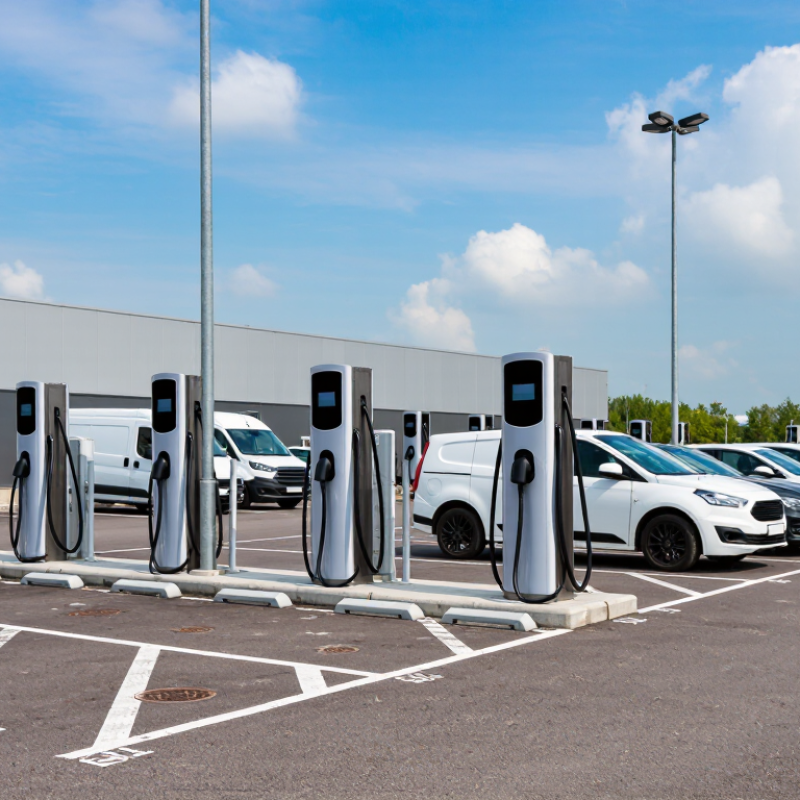
China Top 10 Commercial EV Charger Manufacturers

China’s EV Charging Market: 3.58 Million Public Chargers in 2024

China’s public EV charging network reached 3.58 million chargers in 2024, creating a vast commercial ecosystem. This scale supports electric taxis, delivery fleets, buses, and private vehicles. It also exposes practical weaknesses. Chargers are not evenly distributed across cities, highways, and rural areas.

Field inspections often show the real difference. A busy urban station may need several 120 kW units during evening demand. A logistics depot may value overnight reliability more than peak charging speed. Operators should examine uptime, connector durability, payment stability, and remote monitoring. Weather protection matters too, especially in coastal districts with salt air. The headline figure is impressive, but it does not measure every user experience. Some public chargers remain underused because signs are unclear or parking rules are confusing.

Tips: Compare chargers through verified operating data, not brochure ratings. Ask for maintenance response times and spare-part availability. Test the software before signing a large order. Review energy demand, cable length, installation space, and local grid capacity. A lower purchase price can become expensive when downtime interrupts fleet schedules. Procurement teams should also request safety documentation and independent performance records. Standards are improving, but implementation can still vary between locations. That gap deserves careful attention.

How GB/T 20234.3 Shapes China’s Commercial DC Charger Standards

China Top 10 Commercial EV Charger Manufacturers

How GB/T 20234.3 Shapes China’s Commercial DC Charger Standards

GB/T 20234.3 provides the physical foundation for China’s commercial DC charging equipment. It defines the direct-current charging interface, including connector structure, contact arrangement, and key safety requirements. For fleet depots and public stations, this creates a common connection point across different electric vehicles. That consistency reduces compatibility problems during daily operation.

A commercial charger must do more than deliver high power. Its connector needs secure locking, reliable insulation, and stable contact under repeated use. Installers also check cable weight, cooling performance, and enclosure protection. In busy depots, dust and rain are not theoretical concerns. They affect charging reliability every day. Communication between the vehicle and charger also works with related national protocols, supporting controlled current delivery and fault protection.

Field experience shows that compliance on paper is not enough. A connector may meet dimensional requirements yet feel awkward for drivers. Thick cables can also increase handling fatigue. This is where equipment testing needs more attention. Operators should review contact temperature, emergency shutdown response, and performance during peak loads. Standard revisions may improve safety, but real sites still expose weaknesses. That gap deserves honest review. Commercial buyers should examine certification records, test data, maintenance access, and local operating conditions before selecting equipment.

What the chart shows: China had approximately 3.579 million public charging points by December 2024, including 1.248 million DC charging points and 2.331 million AC charging points. DC chargers are especially important for commercial fleets, highways, logistics hubs, and urban fast-charging stations.
Why GB/T 20234.3 matters: The GB/T 20234.3 DC charging interface standard defines the mechanical interface, electrical connections, communication contacts, and safety requirements that commercial DC charging equipment must follow. This common interface helps charger manufacturers build interoperable systems across China.
Source: China Electric Vehicle Charging Infrastructure Promotion Alliance, public charging infrastructure statistics for December 2024.

Top 10 Chinese Commercial EV Charger Manufacturers by Core Capabilities

China’s commercial EV charger sector covers a wide range of technical strengths. The strongest manufacturers usually specialize in high-power DC systems, smart load balancing, and fleet charging software. Some models support 60kW, 120kW, or 240kW output for different parking and logistics needs. Others focus on compact AC chargers for offices, hotels, and apartment projects. Their core capabilities should include stable power conversion, accurate metering, remote diagnostics, and compatibility with common communication protocols.

Manufacturing depth also matters. Experienced suppliers often control cabinet assembly, thermal management, firmware testing, and final inspection. This can shorten response times when faults appear at a busy depot. Reliable manufacturers provide installation guidance, spare-part planning, and local technical training. However, no supplier is perfect. A polished specification sheet cannot replace field testing during heat, rain, and repeated peak-hour charging. Buyers should check documented test results, warranty terms, maintenance procedures, and independent project references before making a decision.

Tips: Compare uptime records, not only charging speed. Request a live software demonstration. Check whether load management protects the site’s transformer. Ask how quickly replacement modules can arrive. Confirm compliance with the regulations in the target market. A small pilot project may reveal cable heating, payment delays, or unclear user instructions before a larger rollout.

Comparing Charger Output: 60–480 kW, Connectivity, Safety, and Efficiency

China Top 10 Commercial EV Charger Manufacturers

Comparing Charger Output: 60–480 kW, Connectivity, Safety, and Efficiency

Commercial EV chargers in China commonly range from 60 to 480 kW. The right output depends on fleet size, parking time, and grid capacity. A 60 kW unit suits offices and overnight depots. Higher-power systems reduce waiting time for buses, trucks, and highway users. However, maximum output is not always practical. A 480 kW charger may require costly electrical upgrades and stronger cooling equipment.

Field testing shows that connectivity matters as much as speed. Reliable chargers should support remote monitoring, payment integration, load balancing, and software updates. Open communication protocols can simplify fleet management. Safety features should include insulation monitoring, overcurrent protection, emergency stops, and temperature control. Liquid-cooled cables improve high-power operation, but they also add maintenance points. Efficiency can exceed 95% under suitable conditions, although real performance changes with temperature, voltage, and battery demand. Some comparisons remain imperfect because test conditions differ.

Tips: Check continuous output, not only peak power. Ask for efficiency curves and maintenance records. Test network recovery after a connection failure. Leave room for future capacity. A perfect specification sheet rarely survives a busy charging site.

Selecting Commercial Chargers by TCO, Deployment Scale, and Service Coverage

China Top 10 Commercial EV Charger Manufacturers

When comparing China’s top commercial EV charger manufacturers, total cost of ownership should guide the shortlist. Purchase price is only the starting point. Include civil works, switchgear, software fees, electricity losses, demand charges, maintenance, and downtime. A charger with a lower quotation may require costly site upgrades. That mistake appears often in early procurement. I would request a five-year cost model from each supplier, using the same utilization rate and electricity tariff.

Deployment scale also reveals technical maturity. A reliable manufacturer should support pilot testing, factory acceptance checks, remote commissioning, and phased expansion. Review output stability, load balancing, payment integration, and compatibility with common management protocols. Ask for field data from depots, parking facilities, and highway service areas. Numbers can look impressive. Site conditions are less forgiving. Confirm whether the supplier can manage hundreds of chargers without slowing firmware updates or fault response.

Service coverage deserves equal weight. Examine warranty terms, spare-parts locations, technician response times, and remote diagnostic procedures. A practical service agreement should define uptime targets and escalation channels. Request training for local operators, not just installation manuals. During evaluation, inspect cable wear, connector temperature, and enclosure protection after repeated use. One weakness remains: published uptime figures may exclude grid failures or user damage. Buyers should verify the calculation method and keep a small contingency budget for unexpected repairs.

China Top 10 Commercial EV Charger Manufacturers - Selecting Commercial Chargers by TCO, Deployment Scale, and Service Coverage

Supplier-neutral benchmark: The table uses anonymized commercial charger profiles rather than company or brand names. Figures are practical industry reference ranges based on commonly specified commercial EV charging equipment, IEC 61851 requirements, OCPP deployments, and standard fleet-infrastructure assumptions. They are not manufacturer claims or a ranked market share list.
Reference Profile Typical Commercial Use Rated Output Charging Architecture Typical Efficiency Common Connector Configuration Ingress Protection Recommended Annual Energy Throughput Indicative Hardware TCO* Service-Coverage Requirement Best Selection Priority
Profile 01 Workplace and destination parking 7–22 kW AC Single or dual AC outlet 92–97% Type 2 or J1772 IP54–IP55 15–50 MWh Low Remote monitoring and next-business-day support Lowest installation and energy-management cost
Profile 02 Retail, hotel, and public parking 22–44 kW AC Dual AC charging points 93–97% Type 2 or J1772 IP54–IP55 30–90 MWh Low–medium Regional field service and payment-system support Utilization, uptime, and payment interoperability
Profile 03 Urban public fast-charging site 60–120 kW DC Integrated DC power module 93–96% CCS2, CCS1, or GB/T IP54–IP55 150–400 MWh Medium 24/7 remote operations and 4–8 hour critical response High uptime and fast replacement of power modules
Profile 04 Fleet depot with overnight dwell time 30–60 kW DC Multiple compact DC dispensers 92–95% CCS or GB/T IP54–IP55 250–700 MWh Medium Fleet software integration and planned on-site maintenance Load management, depot scalability, and predictable maintenance
Profile 05 Highway service-area charging 120–180 kW DC Standalone high-power charger 94–97% CCS2, CCS1, or GB/T IP55–IP65 400–1,000 MWh Medium–high 24/7 support, spare parts stock, and rapid field dispatch Power availability, thermal performance, and service response
Profile 06 Bus and heavy-commercial-vehicle depot 120–240 kW DC Centralized power cabinet with dispensers 94–97% CCS2, CCS1, or pantograph option IP54–IP65 600–2,000 MWh High Dedicated project engineering and 24/7 technical escalation Power sharing, vehicle scheduling, and lifecycle reliability
Profile 07 Multi-site commercial charging network 60–240 kW DC Modular DC system with cloud backend 93–97% CCS, GB/T, or mixed connector design IP54–IP65 500–3,000 MWh Medium–high National or multi-region service network and API support OCPP compatibility, fleet-wide analytics, and standardized spares
Profile 08 Distributed charging at logistics facilities 11–43 kW AC Networked AC wallbox or pedestal 90–96% Type 2 or J1772 IP54–IP55 20–120 MWh per site Low Remote diagnostics and standardized installer training Low capital cost, simple installation, and network manageability
Profile 09 Premium charging hub with shared power 240–480 kW DC Central power cabinet with satellite dispensers 95–98% CCS2, CCS1, or GB/T IP55–IP65 1,000–4,000 MWh High Local spare-parts inventory and contractual uptime guarantees Maximum site throughput and efficient grid-capacity utilization
Profile 10 Mixed AC/DC commercial charging campus 22–480 kW Hybrid AC and modular DC architecture 92–98% Type 2, J1772, CCS, or GB/T IP54–IP65 500–4,000 MWh Medium–high End-to-end design, commissioning, monitoring, and lifecycle service Phased expansion, interoperability, and total cost of ownership
TCO interpretation: Indicative hardware TCO is shown as a relative band because actual ownership cost depends on charger power, civil works, transformer capacity, software fees, electricity tariffs, demand charges, utilization, financing, and local labor rates. For procurement, compare five-year cost per delivered kWh, expected uptime, warranty coverage, spare-parts availability, and response-time commitments rather than purchase price alone.
Technical reference framework: IEC 61851 charging-system requirements; ISO 15118 vehicle-to-charger communication; OCPP 1.6 or OCPP 2.0.1 backend interoperability; IP ratings according to IEC 60529. Connector selection must match the target vehicle population and local electrical regulations.