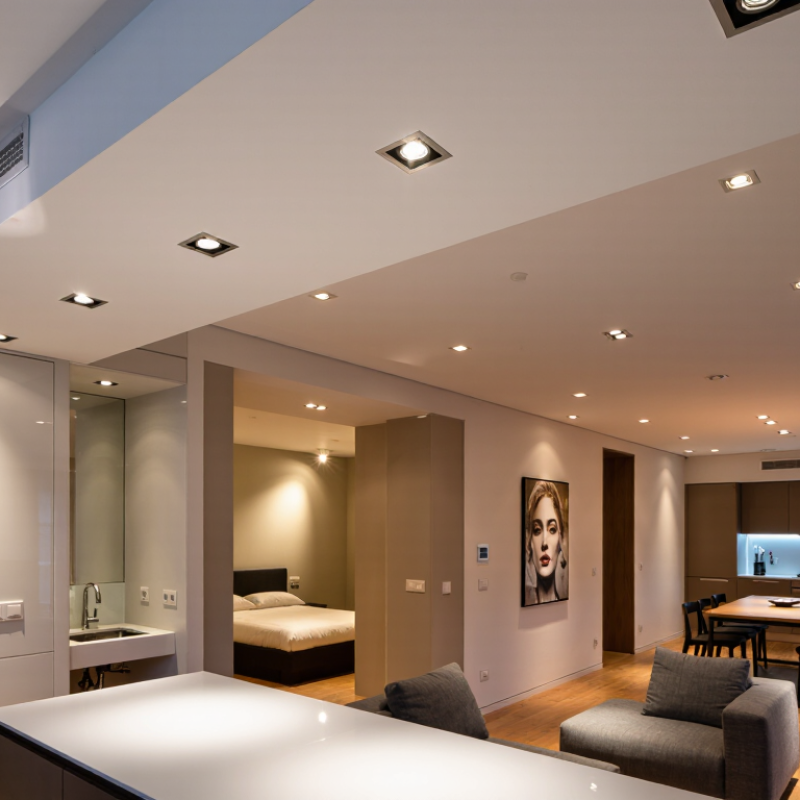
What Is a Recessed Downlight and Which Type Is Best?
A Recessed Downlight can make a ceiling appear clean, bright, and visually calm. Yet choosing one is not as simple as selecting the highest lumen rating. The right fixture depends on ceiling depth, insulation, room moisture, beam angle, dimming needs, and the atmosphere you want to create. A warm 2700K light may soften a bedroom, while 3000K often suits kitchens, hallways, and living areas. Small details matter.
I have seen attractive installations fail because the housing was too deep, the trim reflected glare, or the dimmer was incompatible. These mistakes are easy to overlook. This guide explains the main types, including fixed, adjustable, new-construction, retrofit, and integrated LED models. It also examines IC-rated housings, wet-location requirements, color rendering, and light distribution. Manufacturer specifications and local electrical requirements should always guide the final decision. A qualified electrician can confirm safe installation, especially around insulation or damp ceilings.
There is no universal winner.
The best Recessed Downlight balances performance, comfort, appearance, and long-term reliability. A narrow beam can highlight artwork, but it may create harsh bright spots across a work surface. A wide beam spreads light gently, although it may feel less dramatic. Even experienced installers sometimes revise a layout after seeing real shadows in the room. That practical uncertainty deserves attention. By comparing each option honestly, homeowners and designers can choose lighting that looks good at night and remains sensible years later.
What a Recessed Downlight Is and How It Fits Into a Ceiling
A recessed downlight is a ceiling fixture installed inside a cutout, so only its trim and lens remain visible. The housing sits above the ceiling, while the lamp or LED module directs light downward. It creates a clean appearance without hanging below the surface.
The ceiling cavity determines how the downlight fits. Joists, insulation, ductwork, and wiring can limit placement. In an insulated ceiling, choose a housing rated for direct insulation contact. For a shallow cavity, a slim design may fit better, but it still needs suitable heat management. A qualified electrician should check the space before cutting. Small errors can leave an uneven row.
New ceilings usually allow easier housing installation between joists. Existing ceilings need careful measurements and access planning. The trim should sit flat against painted plasterboard, not press against an uneven edge. Adjustable downlights suit artwork or kitchen counters, while fixed types provide simpler general lighting. Damp areas require a fixture with the correct location rating.
A narrow beam can create sharp pools of light. A wider beam feels softer across a room. I have seen layouts look balanced on paper but feel too bright after installation. Ceiling height, wall color, and furniture change the result. A dimmable option adds control, although compatibility must be checked before purchase. No layout is perfect. Test one position first when possible.
The Main Components That Determine a Downlight’s Performance
What Is a Recessed Downlight and Which Type Is Best?
The Main Components That Determine a Downlight’s Performance
A recessed downlight sits inside the ceiling, creating a clean, directed beam. Its performance depends on more than LED brightness. The LED package affects efficacy, color stability, and lifespan. The U.S. Department of Energy’s 2023 Solid-State Lighting R&D Opportunities report notes that laboratory LED efficacy can exceed 200 lumens per watt. Real fixtures deliver less after optical and driver losses.
The driver converts incoming power into stable LED current. A poor driver may cause flicker, noise, or early failure. Optics shape the beam, while the reflector and trim control glare. Deep trims usually reduce visible glare, but they can also lower light output.
Thermal design matters too. Heat sinks move heat away from the LED junction. High temperatures accelerate lumen depreciation. IES LM-79 testing measures complete fixture performance, while LM-80 and TM-21 help evaluate LED lumen maintenance. These tests are useful, not perfect.
Tips: Check delivered lumens, beam angle, color temperature, CRI, dimming range, and driver warranty. For kitchens, 90+ CRI can reveal food color more naturally. In bathrooms, select suitable moisture protection. Do not choose by wattage alone. A high lumen number can still disappoint. Field inspections often find uneven ceilings, harsh glare, or incompatible dimmers. I would also question unusually long lifetime claims unless testing conditions are clearly stated. Lighting decisions need measured data and real installation context.
How Downlights Differ by Housing, Trim, and Light Source
What Is a Recessed Downlight and Which Type Is Best?
A recessed downlight sits inside the ceiling, leaving only its trim visible. Its housing protects wiring and controls heat around the light source. New-construction housings attach to exposed joists, while remodel housings fit through a ceiling cutout. Insulation-contact and airtight ratings matter when insulation surrounds the fixture. In practice, installers often find that a poor seal causes drafts and unwanted ceiling stains.
The trim changes both appearance and visual comfort. Baffle trims soften glare with a ribbed interior, while reflector trims produce a brighter, sharper beam. Adjustable trims help aim light at artwork or kitchen worktops. However, a narrow beam can create harsh bright spots. This detail is easy to miss. The U.S. Department of Energy reports that LED lighting uses at least 75% less energy than incandescent lighting and can last up to 25 times longer. Those figures support LED selection, but efficiency alone does not guarantee comfortable light.
The light source may be an integrated LED module or a replaceable lamp. Integrated LEDs are slim and often offer better airtight designs, but replacement can be less convenient. Replaceable lamps simplify future changes and color adjustments. Choose a warm 2700–3000K source for bedrooms and living rooms. Use 3500–4000K carefully in work areas. The International Energy Agency estimates that lighting consumes about 15% of global electricity. Still, I would not specify fixtures by efficiency alone. Check glare, color rendering, dimmer compatibility, housing rating, and access for maintenance.
How to Compare Brightness, Beam Angle, Color, and Dimming
What Is a Recessed Downlight and Which Type Is Best?
A recessed downlight sits inside the ceiling, directing light downward through a trim or lens. The best model depends on the room, not just its lumen rating. A living room may need 800–1,200 lumens per fitting, while a hallway often needs less. The U.S. Department of Energy reports that LEDs use at least 75% less energy and can last up to 25 times longer than incandescent lamps. Still, more brightness can create glare.
Compare beam angle carefully. A 24-degree beam creates a tight pool on artwork or a kitchen island. A 60-degree beam spreads light across a sitting area. Spacing matters too. I once selected bright, narrow downlights for a small room; the ceiling looked sharp, but the floor felt unevenly lit. That was a useful mistake.
Color temperature changes the room’s mood. Around 2700K feels warm, while 3000K appears cleaner without looking overly blue. For kitchens and work areas, choose a high color rendering index, preferably 90 or above. The IES TM-30 method also evaluates color fidelity and gamut, offering more detail than CRI alone. Check dimming compatibility before installation. A driver rated for phase-cut dimming may still flicker with a poorly matched control. ENERGY STAR guidance supports verifying tested performance, rather than trusting packaging claims. Review lumens, beam angle, CRI, rated life, and dimmer compatibility together. Claims can be imperfect. Specification sheets deserve scrutiny.
What Is a Recessed Downlight and Which Type Is Best?
Representative lumen output helps compare common recessed downlight types. Actual performance varies with aperture size, optics, ceiling height, and installation conditions.
How to Compare the Main Specifications
| Downlight Type | Typical Brightness | Beam Angle | Common Color Temperature | Dimming |
|---|---|---|---|---|
| Fixed downlight | 600–1,000 lm | 40°–100° | 2700K–4000K | Often dimmable with a compatible LED dimmer |
| Adjustable or gimbal | 700–1,100 lm | 24°–60° | 2700K–4000K | Usually dimmable when matched with the correct driver |
| Wall-wash downlight | 600–1,000 lm | 30°–60° | 2700K–3500K | Commonly dimmable with compatible control equipment |
| Trimless downlight | 500–900 lm | 36°–90° | 2700K–4000K | Dimming depends on the integrated driver |
Quick guide: Choose lumens for overall brightness, beam angle for light spread, color temperature for visual mood, and dimming compatibility for flexible control. A narrow beam suits accent lighting, while a wider beam provides more even general illumination.
Which Recessed Downlight Type Best Suits Each Space and Installation Need
A recessed downlight sits inside the ceiling, creating a clean beam without a hanging fixture. The best type depends on the space and installation conditions. In a hallway, a fixed downlight usually provides even, practical illumination. In a kitchen, choose a wider beam for worktops and food preparation areas. A gimbal downlight helps direct light toward shelves, artwork, or a dining table. Keep it restrained.
New construction allows housing to be secured between ceiling joists before drywall installation. Remodel housing suits existing ceilings and uses spring clips or similar supports. For bathrooms, covered patios, or other damp locations, select a suitable moisture-rated design and follow local electrical requirements. If insulation touches the ceiling, use housing approved for insulation contact. A qualified electrician should verify clearances, wiring, and circuit capacity.
Color temperature changes how a room feels. Warm white light can soften bedrooms and living rooms, while neutral white often supports kitchens and home offices. Dimming is valuable, but the dimmer and driver must be compatible. A common mistake is choosing brightness before considering beam angle. I have seen a bright narrow beam create harsh spots on a countertop. Testing one light first can reveal this problem. Ceiling height, surface color, and trim depth also affect the result. The “best” fixture is sometimes the less powerful one.
What Is a Recessed Downlight and Which Type Is Best? — Which Recessed Downlight Type Best Suits Each Space and Installation Need
| Downlight Type | Best-Suited Spaces | Typical Beam Angle | Main Installation Requirement | Recommended Ceiling or Mounting Condition | Key Advantages | Important Considerations |
|---|---|---|---|---|---|---|
| Fixed Recessed Downlight | Best for general lighting Living rooms, bedrooms, hallways, offices and circulation areas | Approximately 60°–120°, depending on the lamp or LED module | Requires a ceiling cut-out and sufficient space for the housing, driver and wiring | Flat ceilings where the light direction does not need regular adjustment | Simple appearance, efficient installation and even ambient illumination | The light direction is fixed; spacing and beam angle must be planned carefully |
| Adjustable or Gimbal Downlight | Best for directional lighting Art displays, feature walls, retail areas, sloped ceilings and task zones | Commonly 24°–60° for accent or focused lighting | Needs a compatible adjustable trim and adequate clearance for tilt movement | Flat or angled ceilings where the beam must be aimed at a specific surface | Directs light toward artwork, shelving, worktops or architectural details | Tilting can create glare or visible dark areas if the fixture is poorly positioned |
| Low-Profile or Slim Downlight | Best for shallow ceiling voids Renovations, apartments, corridors and ceilings with limited plenum depth | Usually 90°–120° for broad general illumination | Requires less recess depth than many traditional housings, but still needs driver access and wiring space | Shallow suspended ceilings, plasterboard ceilings and retrofit projects | Solves depth limitations and usually provides a clean, unobtrusive finish | The remote driver may require a separate accessible location; verify heat management |
| IC-Rated Downlight | Best near insulation Insulated residential ceilings and areas where insulation may contact the fixture | Varies by design; approximately 60°–120% for general models | Must be specifically marked and installed according to local electrical and fire-safety requirements | Ceilings with insulation around or over the recessed housing | Designed to manage heat when installed in permitted insulated assemblies | “IC-rated” requirements differ by jurisdiction; do not cover or modify the housing unless permitted |
| Fire-Rated Downlight | Best where ceiling fire integrity matters Multi-level homes, apartments and ceilings separating floors or protected rooms | Commonly 60°–100%, depending on the optical design and certification | Requires a tested fire-rated assembly with the correct fitting, driver, cut-out and ceiling construction | Plasterboard or other ceiling systems requiring a specified fire-resistance period | Helps maintain the tested fire performance of a compatible ceiling system | Fire rating is installation-specific; the fixture alone does not guarantee the whole ceiling rating |
| Damp-Rated Downlight | Best for humid areas Bathrooms, laundry rooms, covered porches and utility areas | Approximately 60°–120%, based on the intended lighting purpose | Requires a suitable moisture rating and installation within the electrical zone permitted by local codes | Areas exposed to humidity, condensation or occasional moisture; wet locations may require a higher rating | Better protection against moisture than standard dry-location fixtures | Damp-rated does not automatically mean suitable for direct water spray or immersion |
| Wet-Rated Downlight | Best for direct water exposure Shower areas, exterior soffits and other locations exposed to splashing water | Often 60°–100%, with the final choice based on coverage and glare control | Must carry the required wet-location certification and be installed with suitable seals and connections | Locations where water can contact the fixture directly, subject to local regulations | Provides greater protection against water ingress than dry- or damp-rated products | Confirm the permitted installation zone, IP or equivalent rating, and compatibility with the ceiling system |
| IP65 or Higher Downlight | Best where dust and water protection are specified Bathrooms, shower ceilings, exterior soffits and dusty service areas | Commonly 60°–100%; narrow beams suit accents, wider beams suit general lighting | Requires the stated ingress-protection rating for the exposed front or complete fitting, as specified | Moist or dusty locations where an IP rating is required by the project specification | Provides a clearly defined level of protection against solids and water ingress | The IP rating does not replace electrical-zone rules, fire requirements or correct sealing |
| LED Retrofit Downlight | Best for upgrading existing fittings Residential refurbishments, commercial upgrades and energy-efficiency projects | Typically 80°–120% for broad replacement lighting; some models are narrower | Requires matching the existing cut-out size, supply voltage, driver arrangement and mounting method | Existing recessed apertures where the new module is compatible with the housing | Can reduce energy use and maintenance compared with many older lamp technologies | Check dimmer compatibility, heat dissipation, color temperature and the condition of the existing housing |
| Smart or Dimmable Downlight | Best for flexible control Living areas, bedrooms, hospitality spaces and smart-home installations | Usually 80°–120% for ambient lighting, with narrower options for accent use | Requires compatible controls, wiring, dimmers, gateways or wireless network coverage as applicable | New or existing ceilings where control infrastructure and driver access can be provided | Enables dimming, scheduling, scene setting and sometimes adjustable color temperature | Confirm minimum load, dimmer compatibility, wireless reliability and standby power behavior |
| Color-Tunable Downlight | Best for changing atmosphere Hospitality, living rooms, bedrooms, retail displays and multipurpose spaces | Frequently 80°–120% for flexible ambient coverage | Needs a compatible control system and a driver designed for color-temperature or color adjustment | Spaces requiring different light appearances for relaxation, work or presentation | Allows adjustment of color temperature, and in some systems, color output or scenes | More complex than fixed-white lighting; verify color quality, control method and commissioning needs |
| High-CRI Downlight | Best for accurate color appearance Kitchens, bathrooms, dressing rooms, galleries, retail and photography areas | Commonly 24°–60° for focused display lighting or 60°–100° for general lighting | Requires a specified color-rendering performance, often with attention to R9 or saturated red rendering | Spaces where finishes, food, skin tones or merchandise must appear natural | Reveals colors more faithfully than basic low-CRI lighting | Higher CRI does not automatically mean higher brightness, lower glare or better energy efficiency |
| Anti-Glare or Baffle Downlight | Best for visual comfort Offices, kitchens, study rooms, hospitality areas and low-glare residential interiors | Often 40°–90%, depending on the reflector, baffle and optical system | Requires correct aiming, spacing and compatibility with the ceiling depth and trim design | Areas where occupants frequently look toward the ceiling or where screen reflections are a concern | Reduces high-angle brightness and can improve comfort when properly selected | May produce less light output than an open reflector; review delivered lumens and glare data |

Selection should be verified against local electrical regulations, ceiling construction, insulation conditions, fire requirements, moisture exposure, dimming equipment and the manufacturer’s tested installation instructions. Beam-angle ranges are typical guidance rather than universal specifications.