Why Choose Rebar Wire Rod for Global Construction?
Why Choose Rebar Wire Rod for Global Construction?
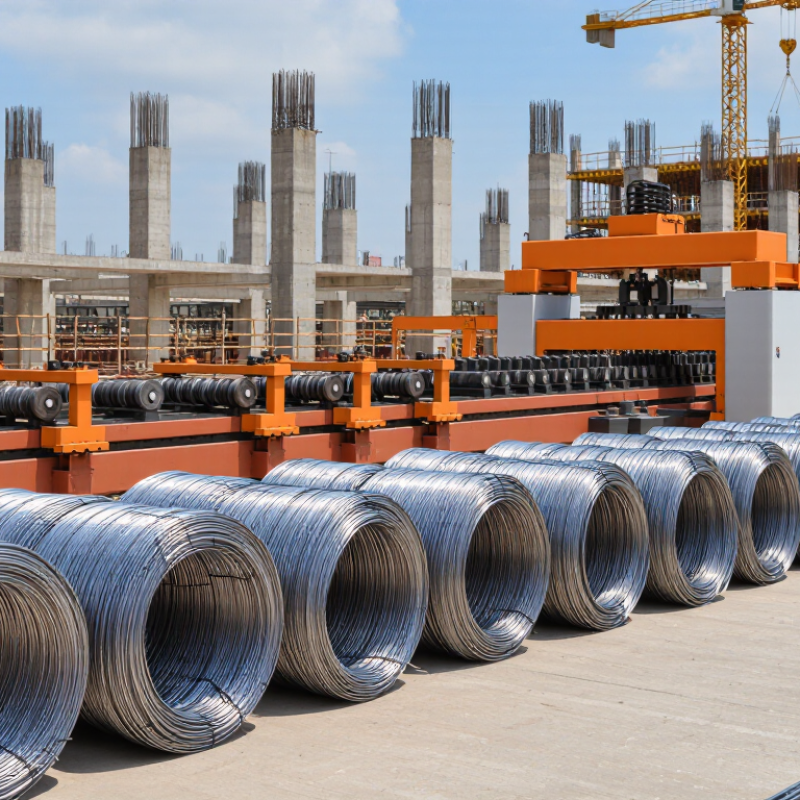
Rebar Wire Rod is becoming an important starting material for reinforced concrete projects worldwide. It arrives in compact coils, rather than long, rigid bars. This form can simplify storage, transport, and automated processing at busy construction sites. A coil can move through straightening and cutting equipment with steady speed. That matters when reinforcement schedules change quickly.
Quality begins before fabrication. Reliable producers control chemical composition, rolling temperature, surface condition, and dimensional consistency. Buyers should request mill certificates, tensile-test results, heat numbers, and traceability records. Project teams must also confirm compliance with the required ASTM, EN, or national standard. One specification cannot fit every market.
Dr. V. Mohan Malhotra, a respected concrete materials expert, has emphasized that “corrosion of reinforcing steel is one of the major causes of deterioration in reinforced concrete structures.” His warning remains practical. Rebar Wire Rod must be protected from prolonged moisture, contamination, and careless outdoor storage. Small rust stains may not always indicate failure, but they deserve inspection. Durability depends on more than steel grade. Concrete cover, mix quality, detailing, and site workmanship all matter.
The economic case is persuasive. Yet, it is not automatic. Cheaper wire rod can create higher costs through rejected batches, inaccurate bending, or delayed testing. A good procurement decision compares landed cost, process efficiency, documentation, and long-term performance. Experience also teaches humility. Even a well-certified coil can be mishandled. Global construction needs dependable steel, careful verification, and people willing to question convenient assumptions.
What Is Rebar Wire Rod and How Is It Made?
Why Choose Rebar Wire Rod for Global Construction?
What Is Rebar Wire Rod and How Is It Made?
Rebar wire rod is a hot-rolled steel product used to make reinforcing bars, wire mesh, and construction ties. It usually arrives as a continuous coil, making storage and transport more efficient than straight bars. Its controlled chemical composition supports strength, weldability, and predictable forming during fabrication.
Production starts with steel billets, which are heated in a reheating furnace. The softened billets pass through several rolling stands, becoming thinner and longer with each pass. A finishing mill shapes the rod to its required diameter. Rapid cooling then helps develop the target mechanical properties. Finally, the rod is coiled, inspected, and tested for size, tensile strength, elongation, and surface quality. In practice, temperature control is critical. Small variations can affect consistency, although no process is perfectly uniform.
Tips: Check the diameter, coil weight, steel grade, and test certificates before shipment. Inspect the surface for cracks, heavy scale, or rust. Keep coils raised from wet ground, and protect them from standing water. Good storage matters more than many buyers expect. It can prevent avoidable fabrication problems.
Which Properties Make Rebar Wire Rod Suitable for Construction?
Rebar wire rod is valued for its strength, consistency, and practical handling on construction sites. Its circular profile supports smooth drawing, bending, and forming into reinforcement products. During fabrication, stable diameter reduces adjustment time and material waste. That matters on busy projects.
High tensile strength helps reinforcement resist heavy loads, while adequate ductility allows controlled bending without sudden cracking. Ductility matters. A rod that is strong but brittle can create serious fabrication problems. Weldability is also important for mesh, cages, and prefabricated components. Low and controlled chemical variation supports more predictable welding performance.
Surface quality deserves close attention. Clean, even surfaces improve bonding with concrete and reduce weak contact areas. Controlled rust protection can also support storage and transport, although excessive rust should never be ignored. In site inspections, technicians commonly check diameter tolerance, coil condition, test certificates, and visible defects. These checks connect laboratory data with real working conditions.
Compliance must match the destination market’s construction standards. Tensile results alone are not enough. Engineers should review yield strength, elongation, bend performance, chemical composition, and traceability records. I have seen specifications appear complete while missing a small but important testing requirement. That is why independent verification remains worthwhile, even when production records look reliable.
Why Choose Rebar Wire Rod for Global Construction?
Strength and ductility are key properties that make rebar wire rod suitable for reinforced concrete, welded mesh, and prefabricated reinforcement. The chart shows the minimum characteristic values specified for common B500 reinforcement classes under EN 10080.
All three classes provide a characteristic yield strength of 500 MPa. Higher tensile-strength requirements and ductility classes provide greater deformation capacity and performance under dynamic or seismic loading. Actual product values may vary by applicable standard, diameter, and manufacturing specification.
How Is Rebar Wire Rod Used in Reinforced Concrete Structures?
Rebar wire rod is used as the starting material for several reinforcement products in concrete structures. It is drawn, straightened, cut, bent, or welded into mesh, ties, stirrups, and lattice elements. On a jobsite, workers may place welded wire mesh across a slab before concrete pours. In a column, shaped wire products hold longitudinal bars in position and resist shear forces. Small details matter. A loose tie can shift reinforcement during vibration.
The World Steel Association reports that construction consumes about half of global steel demand. Its World Steel in Figures 2024 also recorded approximately 1.89 billion tonnes of crude steel production in 2023. These figures explain why consistent wire rod quality matters across international projects.
Engineers typically check yield strength, ductility, weldability, diameter tolerance, and surface condition. ACI 318-19 and EN 10080 provide widely used guidance for reinforced concrete reinforcement.
However, compliance is not automatic. Mill certificates must match laboratory tests and project specifications. Excessive rust, poor bending, or incorrect storage can weaken site performance. That risk is easy to underestimate.
Wire rod should remain elevated from wet ground, covered from standing water, and identified by heat number. In practice, rushed handling sometimes causes avoidable damage. Inspection before fabrication remains essential.
What Quality Standards Govern Rebar Wire Rod Production?
Why Choose Rebar Wire Rod for Global Construction?
Rebar wire rod supports consistent reinforcement production across demanding construction markets. Its quality begins with controlled steelmaking, not the final coil. Relevant benchmarks include ISO 16120 for non-alloy steel wire rod, ASTM A510/A510M for carbon steel wire products, and EN 10080 for reinforcing steel. Requirements differ by destination.
The World Steel Association reported 1.89 billion tonnes of crude steel production in 2023.
Such volume makes stable chemistry essential. Producers test carbon, manganese, sulfur, phosphorus, tensile strength, elongation, and surface condition. Buyers should also verify dimensional tolerances, coil weight, weldability, and heat-level traceability.
In practical inspections, a bright coil may still contain internal inconsistencies. Appearance is not proof. Mill certificates need independent sampling and laboratory confirmation.
Tips:
Request the applicable standard before ordering. Match the chemical limits to the intended welding process. Check heat numbers on coils, certificates, and test reports. ISO 9001 certification helps control processes, but it does not replace product testing. The IEA notes that iron and steel production creates about 7% of global energy-related emissions, so responsible buyers should also review recycled content and production energy data. This part is often overlooked. A stronger specification may cost more, yet rework, rejected batches, and unsafe performance cost far more. Standards guide trust, but disciplined verification completes it.
Why Is Rebar Wire Rod Preferred for Global Construction Projects?
On busy construction sites, rebar wire rod is valued for predictable handling and steady conversion into reinforcement products. It can be drawn, cut, bent, or welded, depending on the approved design. That flexibility matters. Uniform diameter and surface condition support accurate fabrication around beams, slabs, and precast components. High tensile performance helps reinforcement carry repeated loads while maintaining structural reliability. However, performance depends on chemistry, cooling practice, testing, and storage—not appearance alone.
Tips: Keep coils dry, label each heat clearly, and inspect for rust, damage, or mixed sizes before fabrication. Use certified test reports, but confirm critical values through independent sampling when project risk justifies it. Check yield strength, elongation, weldability, dimensional tolerance, and local standards before approval. Global projects rarely share identical rules. Requirements may change with climate, seismic activity, joining methods, and inspection procedures.
Coils can simplify transport and feeding where fabrication space is limited. They may also reduce material handling compared with scattered straight lengths. Yet convenience can create risk. Workers might rush bending or select unsuitable equipment. That assumption needs correction. Clear procedures matter as much as the steel. Experienced project teams usually combine supplier documentation, site inspections, and traceable batch records. This approach improves accountability when problems appear later. It is not perfect, but it gives engineers evidence for practical decisions.