
Skip to Content
chevron-left chevron-right chevron-up chevron-right chevron-left arrow-back star phone quote checkbox-checked search wrench info shield play connection mobile coin-dollar spoon-knife ticket pushpin location gift fire feed bubbles home heart calendar price-tag credit-card clock envelop facebook instagram twitter youtube pinterest yelp google reddit linkedin envelope bbb pinterest homeadvisor angies

Top Automotive Electrical Relays Suppliers Worldwide

Automotive Electrical Relays quietly control power across vehicles, from headlamp circuits to cooling fans and battery-management systems. Their compact size hides demanding work: repeated switching, vibration, heat, and tight packaging. Supplier selection therefore involves more than comparing catalog prices. Buyers also assess contact ratings, operating life, qualification evidence, production capacity, and support for changing vehicle architectures.

The scale of the opportunity is substantial. OICA reported approximately 93.5 million motor vehicles produced worldwide in 2023. The International Energy Agency’s Global EV Outlook 2024 reported nearly 14 million electric-car sales that year, about 18% of global car sales. These figures do not measure relay demand directly, but they show the breadth and changing mix of vehicles that suppliers must serve. Electrification also shifts circuit requirements; it does not make every relay application identical.

A useful supplier overview should distinguish established component makers from specialists, and global reach from proven automotive capability. It should examine product portfolios, manufacturing footprints, quality systems, and technical documentation using verifiable company and industry sources. Be careful with market-size estimates: reports may define “automotive relay” differently, making comparisons less reliable than they appear. That matters. The following outline introduces worldwide suppliers while keeping the focus on evidence, application fit, and the practical limits of public data.
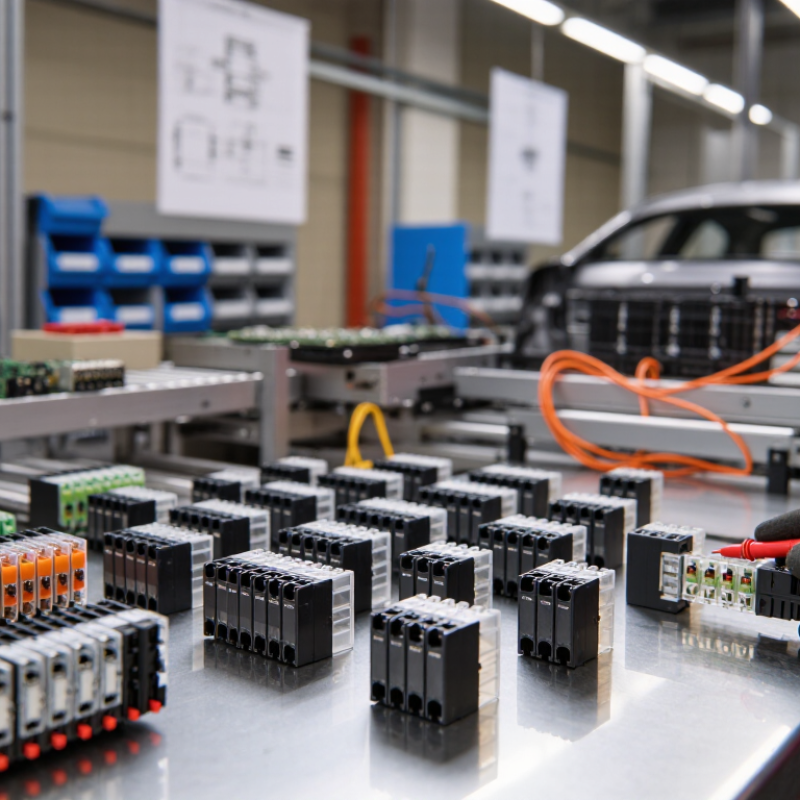
Top Automotive Electrical Relays Suppliers Worldwide

Automotive Electrical Relays: Definition and Core Functions

Automotive Electrical Relays: Definition and Core Functions

An automotive electrical relay is an electrically operated switch that lets a low-current signal control a higher-current circuit. Inside, a coil creates a magnetic field that moves contacts, opening or closing the circuit. This helps a dashboard switch or control unit activate components without carrying their full electrical load. A small click, sometimes.

In a vehicle, relays may control cooling fans, horns, fuel pumps, lights, or starter circuits. For example, when an engine temperature rises, a control signal can energize the fan relay. Its contacts then connect battery power to the fan motor. The control wiring stays relatively light, while the motor receives the current it needs. Exact arrangements vary by vehicle.

Relays also provide circuit isolation and can simplify wiring. They are not universal fixes. Worn contacts, heat, moisture, vibration, or a loose socket can cause intermittent operation, and a click alone does not prove the contacts are working. Diagnosis should include checking the circuit diagram, supply voltage, ground, connector condition, and relay output under load. Even a simple part deserves a careful check.

How Relay Suppliers Support Global Vehicle Production

Global vehicle production depends on relay suppliers that can deliver consistent parts across plants, not just quote a low unit price. A relay may switch a cooling fan, fuel pump, or heated window, so its contact rating and coil voltage must match the vehicle circuit. Suppliers support engineering teams with drawings, sample lots, endurance testing, and material records. Small details matter. Terminal plating, seal fit, and pin alignment can affect assembly speed and long-term reliability.

During a vehicle launch, suppliers coordinate production capacity with automakers and contract assemblers in different regions. They may hold safety stock near a plant, adjust packaging for automated feeders, and flag component changes before they reach the line. Clear lot identification helps teams trace a batch when a test result looks unusual. That saves time. Yet forecasts can shift quickly, and buffer inventory cannot solve every shortage; both sides need realistic demand updates.

Reliable suppliers test relays under heat, vibration, electrical load, and repeated switching, using conditions suited to the intended vehicle application. Test reports should state methods and limits, rather than imply one result guarantees every field outcome. Regional technical support can help investigate a slow or intermittent contact, but diagnosis may still depend on the vehicle harness and installation. There is no perfect handoff. At each site, the approved revision and corrective-action record should match the parts on the production line.

Criteria for Evaluating Automotive Relay Suppliers

A reliable automotive relay supplier should provide more than a catalogue and a headline current rating. Check the rated voltage, switching load, coil power, contact resistance, and specified electrical life. Ask for test conditions, not just pass/fail claims. A relay tested with a resistive load may behave differently with an inductive motor or solenoid. Small details matter.

Environmental validation is equally important. Request evidence for temperature cycling, vibration, humidity, and electrical-transient testing relevant to the vehicle platform. ISO 16750 and ISO 7637 offer useful reference points for automotive environmental and electrical stresses. The International Energy Agency reported nearly 14 million electric cars sold worldwide in 2023, about 18% of new car sales. That shift makes careful review of switching loads and operating conditions especially relevant, though each vehicle design differs. Not enough.

Review the supplier’s production controls, traceability, and change-notification process. Ask whether samples and production parts follow the same materials and manufacturing route, and request inspection records for critical dimensions and contact performance. IATF 16949 certification can support confidence in a quality system, but it cannot replace application-specific validation. A polished datasheet still has blind spots. I would question any supplier unwilling to explain test limits, failure criteria, or how lot-to-lot variation is monitored. Some judgment remains; procurement checklists rarely capture every real-world condition.

Top Automotive Electrical Relays Suppliers Worldwide

Criteria for Evaluating Automotive Relay Suppliers

Suggested evaluation weighting, not measured supplier performance. Prioritize quality systems and reliability, then assess electrical performance, durability, compliance, supply continuity, engineering support, and total cost.

Profiles of Leading Automotive Relay Suppliers Worldwide

Automotive relay suppliers worldwide serve different parts of the vehicle market. Large component manufacturers often support high-volume programs with broad relay ranges and established quality systems. Regional specialists may offer shorter communication lines or configurations for particular vehicle platforms. Some suppliers also work closely with electrical-system integrators, adapting relay specifications to fit control units, wiring layouts, and available installation space.

Their profiles are best compared through practical details, not catalog size alone. Check rated voltage, continuous current, contact material, coil power, operating temperature, and vibration resistance. Ask how suppliers test switching cycles and inspect production batches. Fit matters. A relay that performs well on a bench may behave differently in a hot engine compartment, where dust, moisture, and repeated vibration affect service life. Clear test documentation helps buyers judge that gap.

Delivery capacity, traceability, and engineering support also shape a supplier’s suitability. A global supplier may simplify sourcing across several plants, while a smaller producer could respond faster to a custom requirement. Neither is automatically the better choice. Specifications can look complete, yet some details remain unresolved until prototypes are installed and tested. Buyers should confirm connector compatibility, mounting dimensions, and expected operating conditions before approving a relay for production.

Technology and Market Trends Shaping the Relay Industry

Technology and Market Trends Shaping the Relay Industry

Automotive relay suppliers are adapting to vehicles with more sensors, power electronics, and electrified drivetrains. That shift changes the demands on switching components. A relay must handle heat, vibration, and repeated electrical loads in a compact space. In some applications, engineers are also evaluating solid-state devices alongside electromechanical relays. Neither option fits every circuit. Design choices depend on switching frequency, fault behavior, service needs, and cost.

Small details matter. Contact materials, coil design, sealing, and terminal layout can affect performance over time. Suppliers increasingly use automated assembly and inspection to improve consistency, while test programs reproduce conditions such as temperature cycling and vibration. Yet test results only tell part of the story. Vehicle architectures and operating conditions vary, so component selection still requires careful validation in the intended system.

Market priorities are shifting, too. Electrification is increasing demand for components suited to higher-voltage systems, while conventional low-voltage networks remain widely used. This creates a broad mix of requirements, not one universal solution. Buyers also look for dependable lead times, clear technical documentation, and traceable production. Regional manufacturing can help reduce supply disruptions, though it may add complexity. There is no perfect balance. Even a well-designed relay can be overlooked if its real operating environment is poorly understood.

Top Automotive Electrical Relays Suppliers Worldwide - Technology and Market Trends Shaping the Relay Industry
Technology or supplier segment Typical electrical characteristics Common automotive applications Technology and market trends Supplier evaluation considerations
Electromechanical plug-in relays Commonly designed for 12 V or 24 V vehicle electrical systems. Contact ratings vary by design; 20–40 A versions are widely used, with higher-current designs available. Lighting, horns, fans, pumps, heated equipment, and other switched loads. Continued demand for compact, standardized components, with design improvements focused on contact life, vibration resistance, and packaging. Check rated load, inrush-current capability, contact configuration, coil power, operating temperature, and compatibility with the vehicle’s relay socket.
Miniature and micro relays Smaller packages are available for 12 V and 24 V systems. Current capacity depends on contact size, thermal design, and switching conditions. Space-constrained fuse and relay boxes, body electronics, and lower- to medium-power circuits. Vehicle packaging constraints encourage smaller footprints and higher functional density in electrical distribution modules. Compare dimensions, terminal layout, thermal derating, sealing, and resistance to shock and vibration—not just the nominal current rating.
High-current electromechanical relays Specialized designs can serve loads rated above common plug-in relay ranges; some applications use ratings around 70–100 A, depending on the product and test conditions. High-power fans, auxiliary heaters, pumps, and selected battery or power-distribution circuits. Electrification increases demand for careful management of high-current switching, heat dissipation, and electrical arcing. Assess continuous and switching ratings separately, along with terminal temperature rise, arc management, endurance, and fault protection requirements.
Solid-state relays and semiconductor switches Use semiconductor devices rather than moving contacts. Current and voltage limits are specific to the switching architecture; off-state leakage and heat generation must be considered. Electronic power distribution, frequent switching, and selected loads controlled by vehicle electronics. Integration with electronic control units can support diagnostics and reduce mechanical wear, while thermal design and semiconductor protection remain important challenges. Review conduction losses, heat-sink needs, leakage current, short-circuit behavior, electromagnetic compatibility, and diagnostic functions.
Protective and sealed relay designs Electrical ratings depend on the underlying relay type. Enclosures and seals are selected for the intended installation environment. Engine-bay, underbody, and other locations exposed to moisture, dust, temperature changes, or vibration. Reliability requirements emphasize environmental robustness as vehicle electronics are installed in more varied locations. Confirm the specified ingress protection, temperature range, corrosion performance, terminal materials, and validation conditions for the actual application.
Global supplier capability profile Product portfolios may cover low- and high-current electromechanical relays, miniature formats, and—in some cases—solid-state switching. Passenger vehicles, commercial vehicles, and automotive electrical distribution systems. Automakers and system integrators increasingly assess component quality, design support, production capacity, and supply-chain resilience alongside price. Compare documented quality systems, traceability, change control, production capacity, geographic supply continuity, and application engineering support.
Vehicle electrical-system compatibility Passenger vehicles commonly use nominal 12 V systems; many commercial vehicles use nominal 24 V systems. Operating and transient voltages can differ from nominal values. Relay coils and contacts across vehicle body, chassis, and power-distribution circuits. More electronic loads and control functions increase the importance of testing relays within the vehicle’s electrical environment. Validate coil drive, suppression strategy, load type, transient exposure, and the complete circuit—not only the nominal system voltage.
Standards and validation Test requirements depend on the vehicle, component, and customer specification. Component qualification and integration into vehicle electrical and electronic systems. Environmental, transient, and radio-disturbance testing help address real operating conditions and system-level compatibility. Relevant references include ISO 7588 for automotive electrical relays, ISO 16750 for environmental conditions and testing of electrical and electronic equipment, ISO 7637 for electrical disturbances, and CISPR 25 for radio disturbance characteristics. Applicability depends on the project specification.
Data note: Electrical ranges shown are indicative examples, not universal specifications or supplier rankings. Actual ratings, test methods, and suitability vary by relay design, load type, installation, and vehicle requirements. No company or brand data is included.