
Skip to Content
chevron-left chevron-right chevron-up chevron-right chevron-left arrow-back star phone quote checkbox-checked search wrench info shield play connection mobile coin-dollar spoon-knife ticket pushpin location gift fire feed bubbles home heart calendar price-tag credit-card clock envelop facebook instagram twitter youtube pinterest yelp google reddit linkedin envelope bbb pinterest homeadvisor angies

How to Choose Material Handling Robots for Your Business?

Choosing Material Handling Robots is not simply a matter of comparing payloads or speed ratings. The right system must fit your products, floor plan, workflows, and people. A robot that moves pallets smoothly in a wide aisle may struggle with mixed cartons, tight turns, or changing pickup points. Small details matter. Think about charging locations, handoff zones, floor condition, and what happens when a route is blocked.

Joseph Engelberger, a pioneer of industrial robotics, is often quoted as saying, “I can’t define a robot, but I know one when I see one.” The line is memorable, but today’s buying decisions need more than recognition. Buyers should ask for task-specific demonstrations and verify performance under realistic operating conditions. Measure cycle times, load stability, integration needs, and how easily workers can intervene. Ask what support and spare parts are available, too. A polished demonstration is useful. It is not the whole story.

This guide explains how to compare robot types, assess business requirements, and evaluate safety, software, and total cost. Start with the job, not the machine. Map the route, record typical and peak loads, and note where delays occur. Then compare options such as autonomous mobile robots and automated guided vehicles against those needs. There is no perfect checklist. A rushed estimate can miss awkward edge cases, and I would revisit assumptions after a site trial. The aim is a practical choice: one that solves a defined handling problem and remains useful as operations change.
How to Choose Material Handling Robots for Your Business?

Identify Your Material Handling Needs and Operational Goals

Before selecting a robot, map how materials move through your facility. Record each load’s weight, dimensions, shape, and pickup method. Note whether workers handle cartons, bins, pallets, or mixed items. Small details matter. A glossy carton may slide, while a tall load may wobble during turns. Measure peak-hour volume, not just an average shift. Also mark narrow aisles, floor changes, doorways, and shared pedestrian routes.

Set operational goals that can be measured. You might aim to reduce walking time, move a certain number of loads per hour, or keep production supplied during shift changes. Identify where delays happen now: waiting at a station, searching for empty containers, or queuing at a lift. Then check how a robot would fit existing work. Consider charging windows, loading points, traffic patterns, and what happens when a route is blocked. A faster cycle is not useful if it creates congestion elsewhere.

Some requirements will be uncertain at first. That is normal. A layout drawing can miss a temporary staging area or a floor seam that changes how loads travel. Walk the route during a busy period and speak with the people who use it. Compare the robot’s expected capacity with real peak demand, leaving room for interruptions and changing workloads. Don’t optimize only for today.

How to Choose Material Handling Robots for Your Business

Identify the operating needs that will shape your robot selection.

Example site-assessment scores on a 1–5 scale, where 5 means a high priority. Use your own throughput, load, travel, SKU, labor, and facility data to set priorities; these scores are illustrative, not industry benchmarks.

Compare Robot Types for Specific Handling Tasks

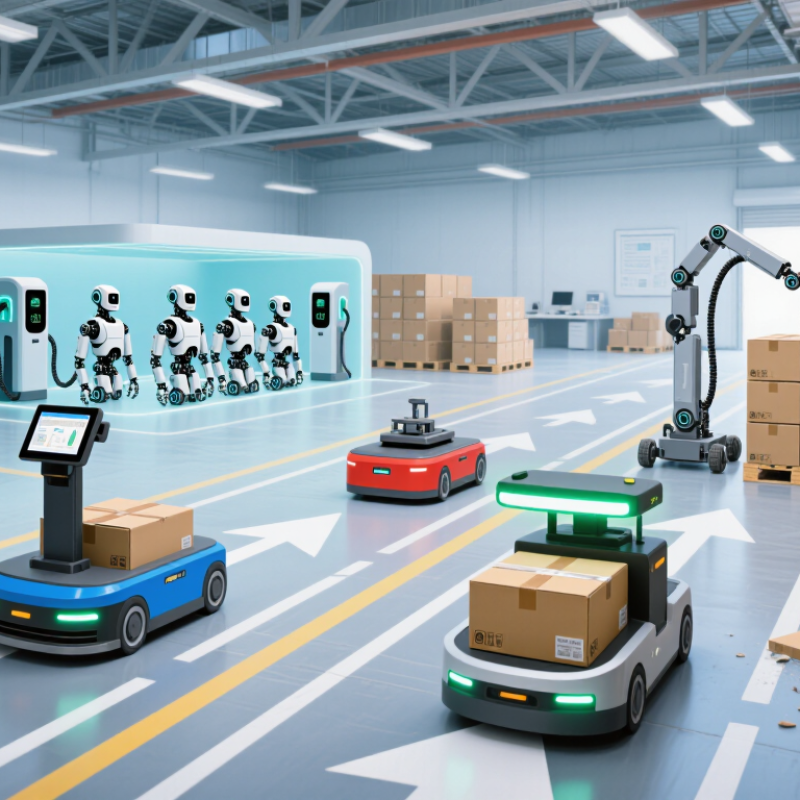
Compare robot types by the work they must perform, not by headline speed. Autonomous mobile robots suit mixed routes between storage, production, and packing areas. They can reroute around changing obstacles, but crowded aisles may slow them down. Automated guided vehicles work well on repeatable paths and steady material flows. They are often easier to plan around, though a blocked route can interrupt the whole cycle. Routes matter.

For precise loading and unloading, articulated robots can move cartons, bins, or components between fixed points. Choose them when reach, payload, and cycle time match the task; a small gripper mismatch can cause repeated stoppages. Cartesian robots move along straight axes, making them useful for predictable transfers, such as placing trays into a machine. Collaborative robots may fit lower-volume stations where people and automation share space, but a risk assessment and suitable safeguards are still essential. Not every aisle.

Measure the heaviest load, item dimensions, travel distance, and required placement accuracy before comparing options. Watch a real shift, too: package sizes change, pallets arrive imperfectly, and operators may use shortcuts. A pilot with representative loads can reveal issues a clean spreadsheet misses. I would not treat that pilot as proof of long-term performance; seasonal peaks and maintenance needs deserve separate checks. Small details count.

Assess Payload, Facility Layout, and System Integration

Choose a robot for the load it will carry in daily work, not just its advertised maximum. Weigh the heaviest pallet, tote, or cart, including packaging and any lifting attachment. Leave capacity headroom for uneven loads and future changes. A 500-kilogram load may behave differently when its weight sits high or shifts during a turn. Check pickup height, fork dimensions, and how often loads vary. These details are easy to overlook.

Map the actual route before comparing models. Measure narrow aisles, doorways, turning areas, and the space beside workstations. Note floor joints, ramps, busy crossings, and places where people pause to handle materials. A robot that fits on a floor plan may still struggle around a queue of carts. Tight turns matter. Check how it will connect with order systems, warehouse software, doors, lifts, and charging stations. Confirm what happens when a connection drops; a manual fallback should be clear. A spreadsheet can miss small obstacles, so test a pilot route during a normal shift.

Tips: Measure with a loaded cart, not an empty one. Ask operators to flag awkward handoffs. Record delays, blocked paths, and missed pickups during the pilot, then adjust the route or robot settings before expanding.

Evaluate Safety, Reliability, and Total Cost of Ownership

Choose a material handling robot by examining the actual routes, loads, and work rhythms in your facility. Measure aisle widths, turning points, floor transitions, and the distance between pickup and drop-off locations. A route that looks clear on a layout may include a blind corner or a busy crossing. Small details matter.

Safety depends on the whole working environment, not just the robot’s built-in sensors. Check how it responds to people, carts, and unexpected obstacles at normal operating speeds. Review emergency stops, warning signals, load stability, and safe access for maintenance. Ask operators to test realistic tasks during a supervised pilot. Test it live.

Reliability should be assessed over representative shifts, including peak periods and routine interruptions. Track completed moves, stoppages, recovery time, and recurring faults; a single successful demonstration proves little. Total cost of ownership includes more than the purchase price. Account for installation, software integration, charging equipment, staff training, maintenance, spare parts, and downtime. A spreadsheet can make the decision look simpler than it is. Pilot data may expose costs or workflow changes that early estimates missed. Compare options using the same operating assumptions, then check whether your team can support the system day to day.

Pilot the Best-Fit Robot and Plan for Future Growth

Pilot the robot in the aisle where work actually happens, not only in a cleared demonstration area. Track payloads, travel distances, charging pauses, blocked routes, and handoffs across a representative shift. Real shifts differ. The International Federation of Robotics reported 541,302 industrial robot installations worldwide in 2023, in its World Robotics 2024 report. That broad adoption signals a mature field, but it does not prove that one robot type fits every facility. Test your own routes and loads.

Set measurable pilot targets before equipment arrives: completed moves per hour, intervention frequency, uptime, and safe interaction with workers. MHI’s 2024 Annual Industry Report found that 55% of surveyed organizations planned to increase investment in supply chain innovation. That figure reflects broader technology spending, not robot purchases alone. Still, it highlights why a pilot should connect to a wider operating plan. Check whether the system can handle added shifts, changing inventory, and new work zones without major redesign. Leave room for doubt. A pilot may reveal awkward bottlenecks, or results may look strong only during quiet hours. Record both, then build a phased expansion plan around verified performance and realistic staffing.

How to Choose Material Handling Robots for Your Business? - Pilot the Best-Fit Robot and Plan for Future Growth
Robot Type Typical Material-Handling Task How It Moves or Works Best-Fit Conditions Key Constraints to Check Useful Pilot Measures Planning for Growth
Autonomous mobile robot (AMR) Moving totes, carts, bins, or other loads between work areas. Uses onboard sensing and a mapped environment to navigate; many systems can adjust routes around obstacles. Repetitive, point-to-point transport in facilities where routes or work locations may change. Load and carrier compatibility, aisle width, floor condition, pedestrian traffic, door and lift access, and integration with work systems. Completed transport missions, delivery time, manual interventions, blocked-route recovery, and availability during operating hours. Confirm that routes, fleet management, charging, and site connectivity can support additional robots and new destinations.
Automated guided vehicle (AGV) Repeated movement of pallets, carts, or loads along established routes. Typically follows defined guidance, such as installed markers, wires, reflectors, or a configured route, depending on the system. Stable workflows with predictable traffic patterns and limited route changes. Guidance infrastructure, route crossings, traffic control, installation disruption, load transfer points, and changes to the facility layout. Successful trips, route delays, interaction with other traffic, loading and unloading accuracy, and time spent waiting. Assess the cost and effort of extending routes and whether future layout changes would require modifications to the guidance system.
Autonomous or automated forklift Transporting and positioning palletized loads, including movement between floor-level and elevated locations when the model is designed for it. Uses vehicle navigation and control systems; operating capabilities vary by truck type and application. Facilities with recurring pallet flows, suitable load presentation, and tasks that can be separated safely from people and other vehicles. Pallet condition and type, load dimensions, rack and aisle clearances, floor capacity, docking accuracy, pedestrian controls, and site safety requirements. Pick-and-place success, pallet damage, positioning accuracy, completed moves, waiting time, and safety-related stops. Check compatibility with rack layouts, pallet standards, traffic-management rules, and planned changes in throughput or storage configuration.
Robotic palletizer or depalletizer Building pallet loads from cases or removing cases from pallets for downstream processing. A robot arm uses an end-of-arm tool and a programmed pattern; vision or other sensing may be used where the application requires it. Repetitive case handling with known product dimensions, stable presentation, and defined pallet patterns. Case range, package strength, pallet quality, layer pattern, infeed consistency, guarding, and required changeover time. Cases handled per operating period, pattern accuracy, dropped or damaged cases, changeover time, and unplanned stops. Plan for additional product formats, pallet patterns, infeed lanes, end-of-arm tooling, and integration with upstream and downstream equipment.
Industrial robotic arm for machine tending or transfer Loading and unloading machines, transferring parts, or handling components within a defined work cell. Moves through programmed paths within its work envelope; the cell may use fixtures, sensors, and safety equipment. Repeatable handling tasks with consistent part presentation and a work area that can be arranged around the robot. Payload including tooling, reach, cycle sequence, part variation, fixture accuracy, machine interface, and cell safety design. Successful transfers, cycle completion, part-placement accuracy, machine waiting time, and recovery time after a fault. Consider whether new parts, tooling, fixtures, or process steps can be accommodated without redesigning the full cell.
Collaborative robot (cobot) for handling tasks Assisting with tasks such as picking, tending, or transferring lighter items in a shared work area, subject to application-specific risk assessment. Designed for applications that may involve close human interaction, but collaboration does not remove the need for safety assessment and safeguards. Tasks where a flexible arm can support an operator and the work can be divided between people and automation. Payload and reach at the required speed, tool design, pinch and impact hazards, task variability, and applicable safety requirements. Task completion, operator handoffs, stoppages, ergonomic changes, quality results, and time needed to change tasks. Evaluate how easily the arm, end-of-arm tooling, and workstations can be redeployed as product mix or staffing needs change.
All robot types: pilot and scale-up checklist Validate a defined material flow before committing to a broader deployment. Run the selected robot on representative shifts, loads, routes, and operating conditions; record exceptions as well as successful cycles. Choose a bounded workflow with a clear starting point, destination, process owner, and baseline for comparison. Include peak periods, mixed traffic, human work, maintenance access, network coverage, charging or power needs, and failure recovery. Compare baseline and pilot results for throughput, task time, intervention rate, damage, availability, safety events, and labor time per completed task. Set measurable expansion criteria; confirm support, training, spare-parts, software, infrastructure, and integration requirements before adding sites or fleets.