
China Top Iron Strainer Manufacturer for Global Buyers
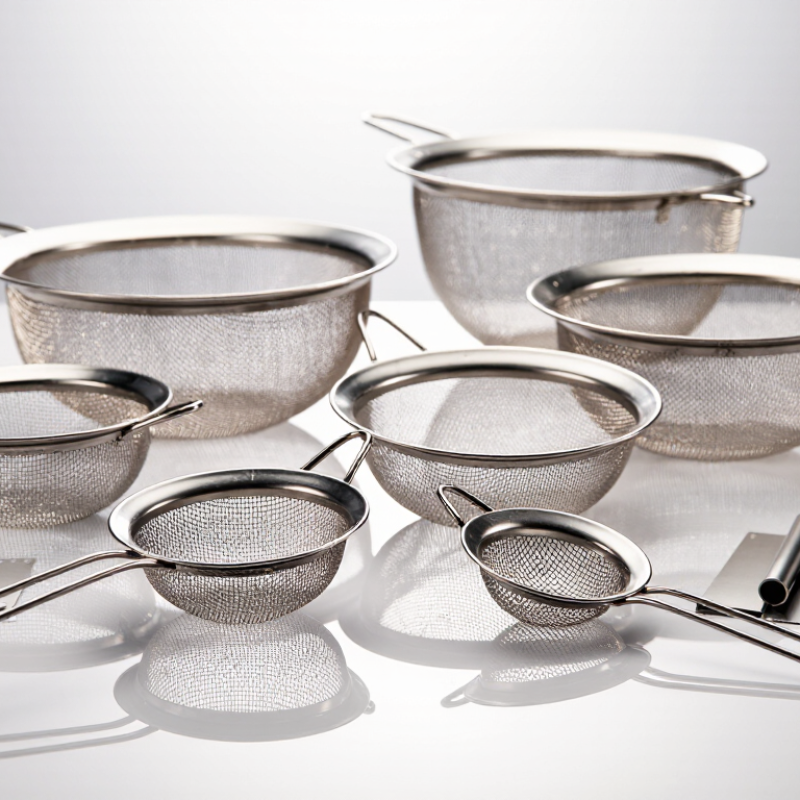
Choosing a reliable China Top Iron Strainer Manufacturer for Global Buyers requires more than comparing prices. The right partner should understand filtration performance, food-contact safety, production consistency, and international purchasing requirements. An Iron Strainer may look simple, yet its mesh accuracy, handle strength, weld quality, and surface finish affect daily use.
Experienced manufacturers usually offer stainless steel grades such as 201, 304, or 316, depending on the application. They should explain these differences clearly, rather than hiding them behind technical language. Buyers can request material certificates, sample inspections, dimensional drawings, and production photos. A useful sample should reveal whether the mesh stays firm, whether the rim feels smooth, and whether water drains evenly.
Small details matter.
Reliable factories often maintain documented quality procedures from raw material inspection to final packing. They may support OEM designs, laser marking, private packaging, and mixed container orders. However, claims still need verification. A polished website cannot replace an independent inspection, especially when large quantities are involved. Some suppliers may also need improvement in communication speed or documentation accuracy. That weakness should be discussed early, not ignored.
This guide examines how global buyers can evaluate Chinese Iron Strainer manufacturers with practical judgment. It considers factory experience, customization ability, quality control, export support, and after-sales communication. The goal is not to promise a perfect supplier. It is to help buyers identify a capable, transparent, and dependable manufacturing partner.
What Defines a Top Iron Strainer Manufacturer in China
China Top Iron Strainer Manufacturer for Global Buyers
What Defines a Top Iron Strainer Manufacturer in China
A top iron strainer manufacturer begins with controlled material, not attractive catalog photos. The World Steel Association reported China produced about 1.005 billion tonnes of crude steel in 2024. This capacity supports stable sourcing, but volume alone proves little. Experienced factories record heat numbers, casting temperatures, and supplier certificates for each production batch. They also inspect wall thickness around the mesh seat, where weak castings often crack. Small details matter.
Process discipline separates a dependable manufacturer from a busy workshop. The ISO Survey 2022 recorded more than 1.76 million ISO 9001 certificates worldwide, with China holding a major share. Certification is useful evidence, yet it cannot replace factory audits. Buyers should examine calibration records, sample approvals, pressure or flow tests, and corrective-action reports. A serious producer can explain why a rejected strainer failed. That answer should include measurements, not excuses.
Export readiness requires more than English packaging. A capable manufacturer confirms thread standards, coating thickness, corrosion resistance, carton drop protection, and inspection sampling before mass production. For cast iron strainers, uneven coating or hidden sand inclusion can appear after installation. Ask for production samples and independent inspection options. One limitation remains: no supplier is perfect. Even a well-managed plant may miss a defect during peak season. Transparent reporting, traceable batches, and a practical replacement process reveal more than polished claims.
| Evaluation Dimension | Typical Technical Data | What Global Buyers Should Verify | Why It Defines a Top Manufacturer |
|---|---|---|---|
| Body Material | Ductile iron, gray cast iron, carbon steel, or stainless steel options. Stainless steel grades commonly include 304 and 316/316L for improved corrosion resistance. | Material grade, chemical composition, mechanical properties, and material test certificate. | Correct material selection affects pressure resistance, service life, corrosion performance, and application suitability. |
| Nominal Size Range | Common pipeline sizes range from DN15 to DN600, equivalent to approximately NPS 1/2 to NPS 24, depending on the product design. | Available DN or NPS sizes, face-to-face dimensions, flange drilling, and dimensional drawings. | A broad and clearly documented size range supports water, HVAC, industrial, irrigation, and process-piping applications. |
| Connection Types | Threaded, flanged, grooved, socket-weld, and wafer-style connections are commonly available for different piping systems. | Connection standard, thread type, flange class, bolt-hole pattern, gasket requirements, and installation dimensions. | Accurate connection dimensions reduce installation problems and improve interchangeability in international projects. |
| Filtration Mesh | Removable screens commonly use perforations or woven mesh selected according to the required particle-retention level. Typical openings may range from about 0.5 mm to 5 mm. | Opening size, open-area ratio, screen material, screen thickness, and replacement-screen availability. | Filtration performance depends on the screen opening, effective area, flow velocity, and pressure-drop requirements. |
| Pressure Rating | Common cast-iron and ductile-iron strainer ratings include PN10, PN16, Class 125, and Class 150, subject to design and standard. | Rated pressure at the specified temperature, hydrostatic test pressure, and applicable design standard. | A clearly stated pressure rating helps buyers match the strainer with the system's operating and test conditions. |
| Operating Temperature | Temperature capability depends on body material, screen material, gasket, lining, and pressure rating. Elastomer seals may have lower limits than metal components. | Temperature range for the complete assembly, including gasket and coating limitations. | Complete temperature data prevents premature seal failure and ensures safe operation in hot-water, steam, chemical, or chilled-water systems. |
| Flow Direction and Pressure Drop | Most pipeline strainers use a marked flow direction. Pressure drop varies with flow rate, screen opening, screen fouling, and open-area ratio. | Flow-arrow marking, pressure-drop curves, recommended cleaning intervals, and maximum allowable differential pressure. | Verified hydraulic data helps engineers size the strainer correctly and protect pumps, valves, and downstream equipment. |
| Surface Protection | Available treatments may include epoxy coating, powder coating, paint systems, galvanizing, or passivation for suitable stainless steel components. | Coating type, dry-film thickness, surface-preparation method, adhesion results, and corrosion-test information where applicable. | Consistent surface protection improves resistance to moisture, handling damage, and the intended service environment. |
| Screen Maintenance | Basket or screen elements are generally removable through a bolted cover. Drain plugs or blowdown ports may be included for easier cleaning. | Cover-access clearance, screen-removal procedure, spare-screen dimensions, gasket replacement method, and drain-port configuration. | Serviceable construction reduces downtime and lowers the total cost of ownership. |
| Manufacturing Process | Typical processes include pattern-based casting, machining, drilling, deburring, coating, assembly, and final inspection. | Process controls for casting defects, dimensional accuracy, machining tolerances, cleaning, and assembly traceability. | Controlled production processes provide more consistent dimensions, sealing performance, and batch-to-batch quality. |
| Quality Inspection | Typical checks include visual inspection, dimensional inspection, material verification, pressure testing, coating inspection, and functional assembly checks. | Inspection plan, test records, sampling method, calibration records, nonconformity procedure, and product traceability. | Documented inspection demonstrates that the delivered products meet the agreed technical specification. |
| Applicable Standards | Depending on the market and design, relevant references may include EN, ASME, API, DIN, ISO, JIS, GB/T, or MSS requirements. | Exact standard edition, product scope, pressure class, face-to-face requirements, and any required third-party certification. | Standards compliance supports project approval, engineering integration, and acceptance by international purchasers. |
| Gasket and Seal Options | Common sealing materials include EPDM, NBR, PTFE, graphite, and other application-specific materials. | Seal compound, temperature range, chemical compatibility, drinking-water suitability, and replacement availability. | The gasket is critical to leak prevention and must match the fluid, temperature, pressure, and regulatory requirements. |
| Customization Capability | Possible customizations include size, connection, screen opening, body material, coating, drain arrangement, logo-free marking, and packaging. | Engineering drawing review, sample approval, tooling requirements, minimum order quantity, and change-control process. | Reliable customization helps manufacturers meet project-specific specifications without compromising technical consistency. |
| Export Documentation | Typical documents include commercial invoice, packing list, certificate of origin, material certificate, inspection report, pressure-test report, and installation instructions. | Document language, document format, shipment requirements, country-specific compliance, and product traceability. | Complete documentation reduces customs delays and simplifies installation, inspection, and future maintenance. |
| Packaging and Logistics | Heavy cast products are commonly protected with pallets, cartons, edge protection, separators, and moisture-resistant wrapping as required. | Net and gross weight, package dimensions, pallet configuration, loading plan, lifting points, and container utilization. | Proper packaging reduces coating damage, deformation, loss of components, and transport-related claims. |
| Warranty and After-Sales Support | Support may include installation guidance, spare-screen supply, replacement gasket information, troubleshooting, and warranty terms defined in the contract. | Warranty duration, exclusions, response time, spare-parts policy, and technical-support channel. | Responsive technical support protects system uptime and demonstrates long-term supply capability. |